Day 1 – North U Performance Racing Week
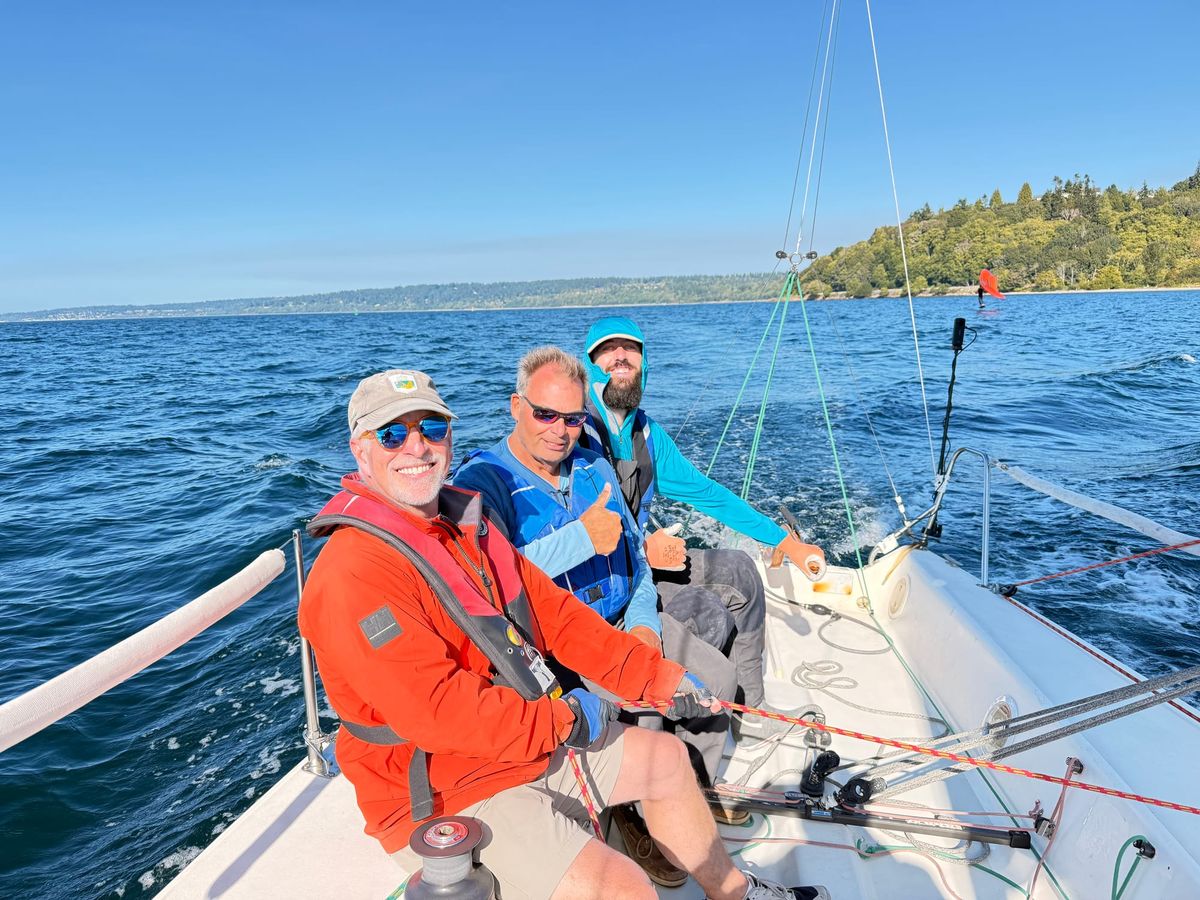
Day one of the North U Performance Racing course is in the bag, and it’s already exceeding expectations. The weather was fantastic yesterday and looks to be even better today — at least temperature-wise. Not sure about the wind yet, but yesterday’s breeze was spectacular.
We’re sailing J/80s from the Seattle Sailing Club program. The fleet is made up of four boats with four sailors each and two boats with three. Alex and I are on Raven, along with Mark Bird from San Francisco, under the guidance of our coach, Terry.
The day started at 9:00 a.m. with an overview and introductions before heading down to the docks. The focus was fundamentals of boat handling: steering, tacking, gybing, douses, and sets. Each sailor rotated through every position during a windward-leeward lap before “snowballing” — Terry’s term for cycling crew (driver to bow, bow to trim, trim to driver).
Terry also gave us several new “tools” that really helped:
- The Happy Place – When driving, sit with one foot on each side of the traveler, knees together, tiller extension firm in your lap, rear hand on the end, forward hand resting on top. This locks in the tiller and reduces “twitchiness.” You press into the helm instead of wiggling it, which steadies angle of heel and heading. It reinforces the mantra: you must go straight to accelerate. Sailing rewards small, deliberate changes.
- The Bubble & Managing Energy – Think of three “spots”: on the bubble, and just to either side of it. This works upwind and downwind. Bearing off (upwind) or heading up (downwind) adds energy; then you shift back on top of the bubble to maintain speed. Go too far and you fall off, losing boatspeed — so you need to return across the bubble to re-energize.
- Landing Tacks & Gybes – The helmsman’s job is to ignore chaos in the boat and focus on the forward sail as it comes across, landing the tack or gybe exactly on the target heading. While crossing the boat, keep eyes fixed on the horizon through the forward sail to avoid wiggling the helm. This simple focus smoothed our turns considerably.
- Reference Marks on Everything – Mark controls for quick visual checks: tape the mainsheet where the boom is on centerline, mark the jib sheet where it hits max trim at the winch. With these references, trim can be seen and communicated instantly without asking or craning your neck.
- “Speak Navajo” – Be Descriptive, Not Prescriptive – Keep comms short and packed with information. Examples: “More pressure and lift,” “Breeze steady across course,” or “Higher and slower than Raven.” Always describe what our boat is doing relative to another. The one exception is trimmer-to-helm downwind: use agreed-upon shorthand like “Up one / up two” or “Down one / down two” instead of vague terms like “soft” or “good pressure.”
- Dousing the Spinnaker – When recovering the asymmetrical, blow tack and clew, then chase the foot to the middle seam and pull that down. This keeps the tack from dragging in the water and makes the sail flap like a flag instead of ballooning.
- Hoisting the Spinnaker – The bow doesn’t leave until the boat’s bow breaks the plane of the mark. Tack is taken just over the pulpit, with the pole retracted. Start the hoist, and when the halyard is halfway up (there’s a bright mark to watch), then extend the pole. This keeps the boat short around the mark, prevents shrimping, and avoids the chute filling too early.
- Gybing the Spinnaker – Ease the sheet quickly to the forestay before trimming the new one. Don’t just dump and grab; that sequence keeps control clean and smooth.
- Standard Operating Procedures Describe each maneuver and the process steps done by each position. If it needs to improve, improve the documentation.
Takeaway: It was a fantastic first day on the water. The instruction was top-notch, blending serious racing credentials with excellent teaching. Everyone in the class is dialed in, and the atmosphere is both focused and fun. Can’t wait to see what we build on today
Light Air j80 tacking
Kristen Berry Spinaker Demo
Opening Session – Performance Race Week
Welcome & Philosophy (Kristen Barry, Director of Performance Sailing, American Sailing / North U)
- Goal: everyone leaves a better sailor than they arrived.
- Unknowns: weather, current, and individual capabilities—but the program + coaches guarantee progress.
- Teaching model: small teams on boats, but all coaches are available to all sailors anytime. Different coaches = different ways of explaining.
- Priorities: Safety, Fun, Learning (all equal).
- Emphasis on hands-on cockpit learning rather than lectures.
- Boats are treated as each team’s responsibility—maintain, improve, and return them in good condition.
- Hydration, sunscreen, and self-care are critical for performance and safety.
Program Background
- North U was historically the education arm of North Sails.
- Merged into American Sailing during the pandemic to build a performance division.
- Bill Gladstone passed leadership to Kristen Barry last year.
- Curriculum built on 40+ years of experience, with elite coaches (America’s Cup, Olympians, world champions, sailmakers, builders).
Daily Structure
- Morning + afternoon sailing blocks (~2.5 hrs each).
- Lunch: working session with reflection + exercises.
- Debriefs each day, using varied styles to teach how to run effective team debriefs.
- Use of drone footage and video for feedback.
Day 1 Focus: Fundamentals of Boat Handling
- Preparation: learn boats, rigging, roles, and tools.
- Execution: tacks, gybes, sets, and douses—aiming for efficiency and consistency.
- Today = “go deep, not wide”: mastering standard maneuvers before strategy/tactics.
- Tomorrow shifts toward boat speed and paired drills.
Coach Intros (highlights)
- Terry Foster (Minnesota): lifelong sailor/coach, Olympic coaching lineage, loves seeing “lightbulb moments.”
- Shayla Youngerman (Santa Barbara): background in cats + monohulls, coaching since childhood, emphasizes diversity of experience.
- Mark Flora (Seattle): racer and coach, stresses top-quality instructors and passion for teaching.
- Drew (Canada): sailmaking + coaching background, believes in open conversation and learning as a team.
- Bobby (St. Thomas): long with North U, values multi-coach perspectives.
- Andrew (UK/Seattle): deep coaching history, emphasizes open dialogue anytime.
Key Takeaways for Sailors
- Treat boats and teammates with care.
- Stay hydrated and manage energy.
- Ask questions freely—no hierarchy among coaches.
- Focus first on strong fundamentals; tactics and advanced strategy come later.
- Expect an immersive, collaborative, fun, and high-level learning environment.
Lunch Debrief — “Process Wins Races”
Core message
- Treat your team like a sports team: recruit, train, retain—and use a playbook/SOPs for maneuvers.
- Consistent process → easier diagnosis and faster improvement.
Demo lesson (45-number grid)
- Random search: slow and error-prone.
- Add a framework (grid) → task completed faster.
- Translation: define step-by-step maneuvers; then add flair once the base is consistent.
Standardize maneuvers
- Build clear sequences for: tacks, gybes, bear-aways, sets/douses (WW/LW).
- Share across boats to converge on best practices.
Comms & decision model
- Sailing is played in the future: describe what’s about to happen, then execute.
- Helms asks permission: “Prepare to tack… ready to tack?” Responses are “Ready” or “Standby” (not “No”).
- Be descriptive, not directive: e.g., “Inside telltale lifting; I’m at max trim,” vs. “Come down!”
Executing a tack (J/80 focus)
- Initiate with sails & body weight first, tiller second:
- Ease windward hike to induce heel; power main / depower jib to encourage head-up.
- Steering profile: effectively a smooth, constant arc that lands accurately so the boat accelerates out.
- Landing accuracy matters:
- Too low → over-trimmed, sluggish; too high → inside telltale lifts, won’t accelerate.
- Calibrate trim: whip marks on sheets; land the jib to the same spot every time.
Post-tack coordination
- If trimmer misses mark: communicate percentage (“I’m at 80%”).
- Helms bows down to accelerate; trimmers call speed build (“41…42…43…”) to time turn-up and trim-in.
- Mantras: “Straight to accelerate.” and “Sails lead, turns follow.”
- Prefer small ‘nibbles’ over big corrections.
Reading errors
- Landed too low signs: “stuck-in-glue” feel; telltales curve with no flow; missing target heel.
- Great sailors excel at pattern recognition—feel + repeat what’s fast.
Targets & tradeoffs
- Proper angles depend on wind; don’t apply the same landing angle in 6 kts vs 12 kts.
- Accuracy first; if you err, slightly fat with quick acceleration is acceptable—then match sails/angle via comms.
Jib release timing
- Self-critique release vs. boat’s rate of turn:
- Too early → jib drags across.
- Too late → backwinds, forces over-steer.
- Aim for the middle—clean, timely cross.
End-of-Day Debrief — Key Lessons & Drills
Kite sets & exit angle
- If the helm bears away so far that apparent wind dies (kite drags behind main between spreader/main), you’re too deep.
- Ideal: bear away until you just feel apparent wind fade, then slightly head up so the kite blows clear as head/tack reach full hoist.
- Drill: trim kite to your best VMG angle, tape-mark the sheet at that trim; on set, cleat at the mark.
- Luffs = too high; gasps/drags = too low.
Tacking mechanics (tiller boats) — “Two-Gate Method”
- Gate 1: push tiller away, wait for the boat to start turning through head-to-wind.
- At the magic moment (boom stops luffing, boat not heeling yet): cross first as helm, tiller rainbow + two-step, pass extension low at belt line, minimal rudder deflection.
- Helm crosses first (big rock); crew crosses on countdown (3-2-1) to flatten and accelerate.
- Boom on centerline upwind: manage heel with twist/draft; traveler & mainsheet are a circuit (raise traveler ↔ ease sheet, and vice versa).
- Video coaching tip: an iPhone + $20 cage centered aft gives great review footage (10-tack drill).
Gybing with asym kites — “Sails lead, turns follow”
- Start with trimmer: ease so clew moves to the headstay, then drop old sheet and rip new to separate clew from tack.
- Helm’s turn rate slightly behind kite easing; aim for brief wing-on-wing, then main floats across softly (no bang).
- Bad gybes came from helm turning ahead of trim or dumping the active sheet too soon.
Crew flow & positions
- In most maneuvers, crew walks uphill; helm goes first so they can land, read telltales, heel, and angle.
- Cross-sheeting: route inactive under active to avoid overrides; calibrate min/max trim and land between them.
- Safety on inside-pull jibes: the forward trimmer should be forward of the shrouds (three-point stance), not aft in the boom’s path.
Sheet/line management
- After hoist, flake halyard into the bag (or feed down the companionway) so it runs clean on douse.
- Cockpit coils? Consider tossing halyard/jackline over the leeward side—water friction smooths the drop.
Helm feel & scan
- Upwind scan loop: Telltales ↔ horizon (landmark) ↔ hips/heel feel.
- Pre-tack landmark: traveler points to your exit angle; land “in the neighborhood,” then fine-tune with telltales.
Communication & culture
- Be descriptive, not directive (“Inside telltale lifting; I’m at max trim” vs. “Come down!”).
- Call percent trims (“I’m at 80%”) so helm matches acceleration and turn.
- Experiment in small ranges—sailing rewards nibbles over big corrections.
Common errors to fix
- Jibe fouls: helm ahead of trim; kite not reaching headstay; or evacuating active sheet too early.
- Tacks landing inconsistent (no sheet marks), boom not on centerline, crew crossing before helm, over-tidy coils causing knots.
Team rotation tips
- Before leaving dock: agree on baseline roles and stick to them for a block.
- After each rotation: hand your successor one quick tip that just worked.
Tomorrow (preview)
- 8:30 AM doors; 9:00 AM session on sail trim & balance (boom centerline, twist, targets).
- On-the-water: boat speed day (paired speed drills).
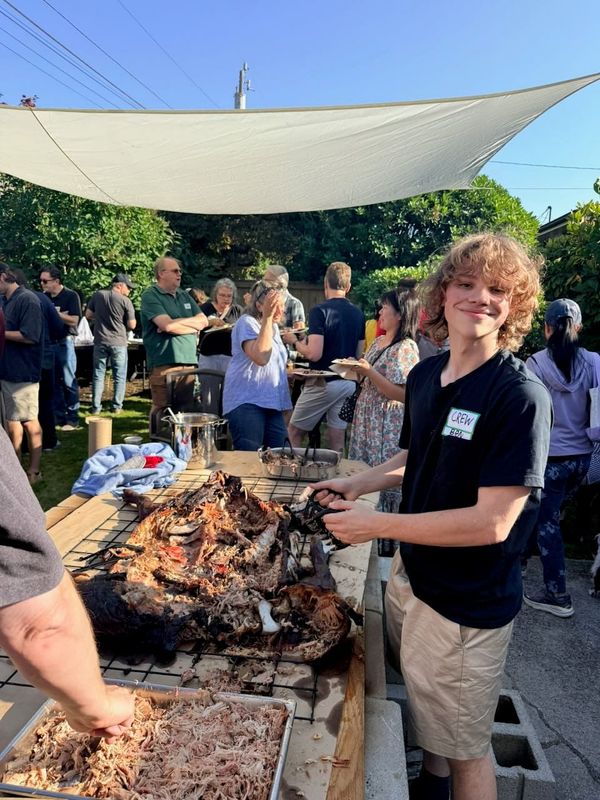
- Evening: hosted Polynesian luau at the club—arrive ~6:00, serving 6:00–6:30, wrap by ~8:00.
- Optional tonight: Sloop Tavern hangout (address in WhatsApp).