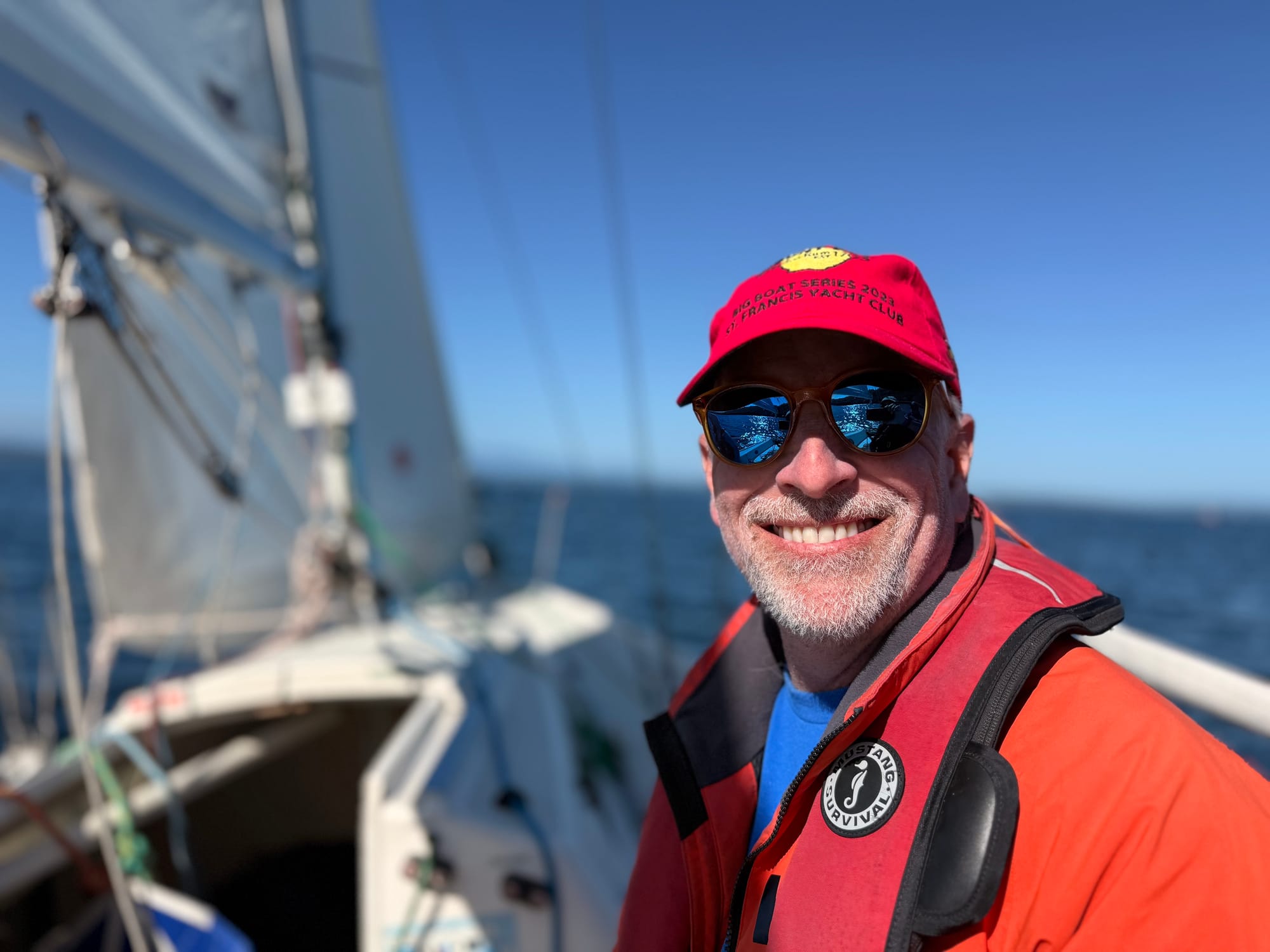
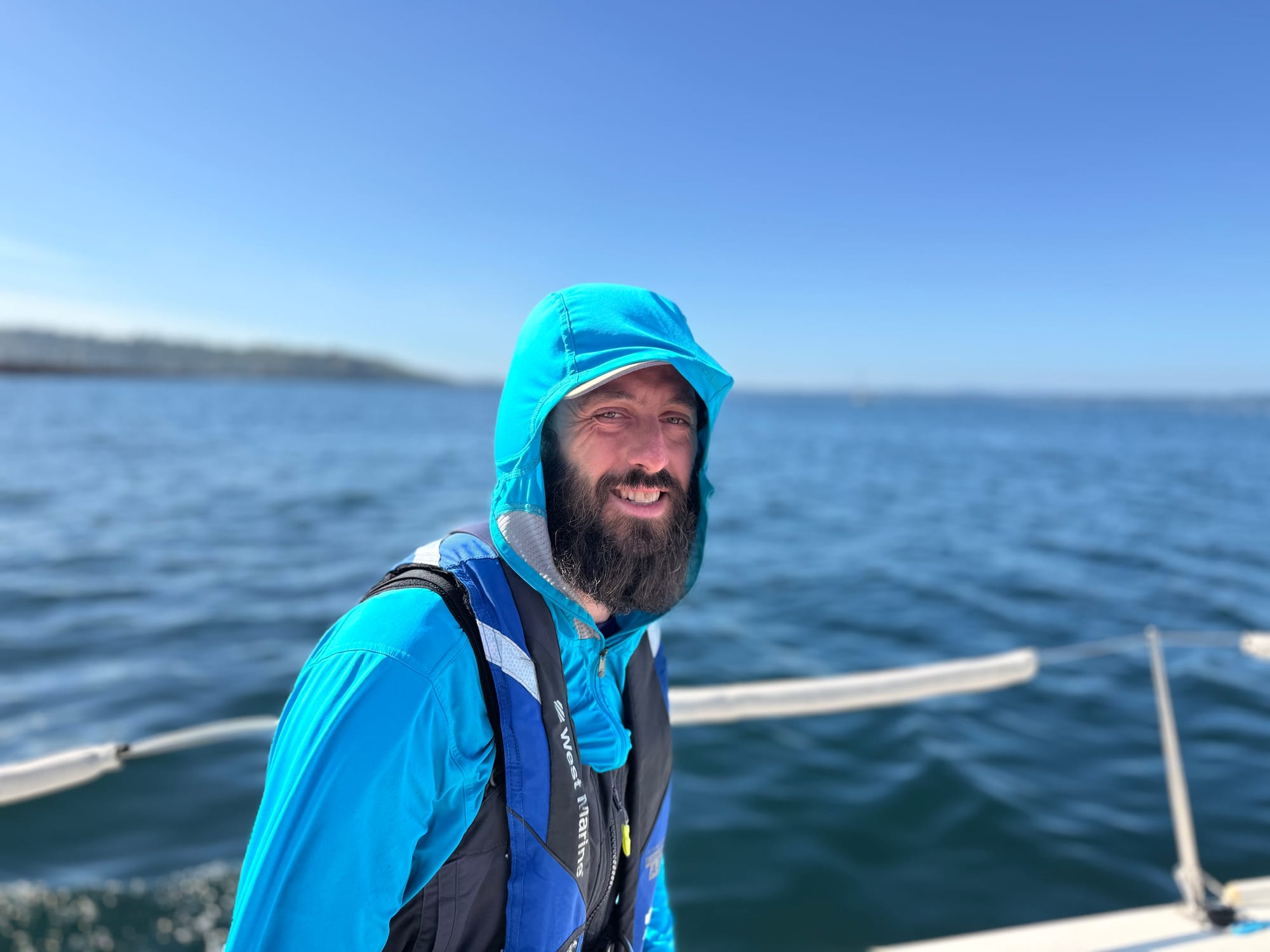
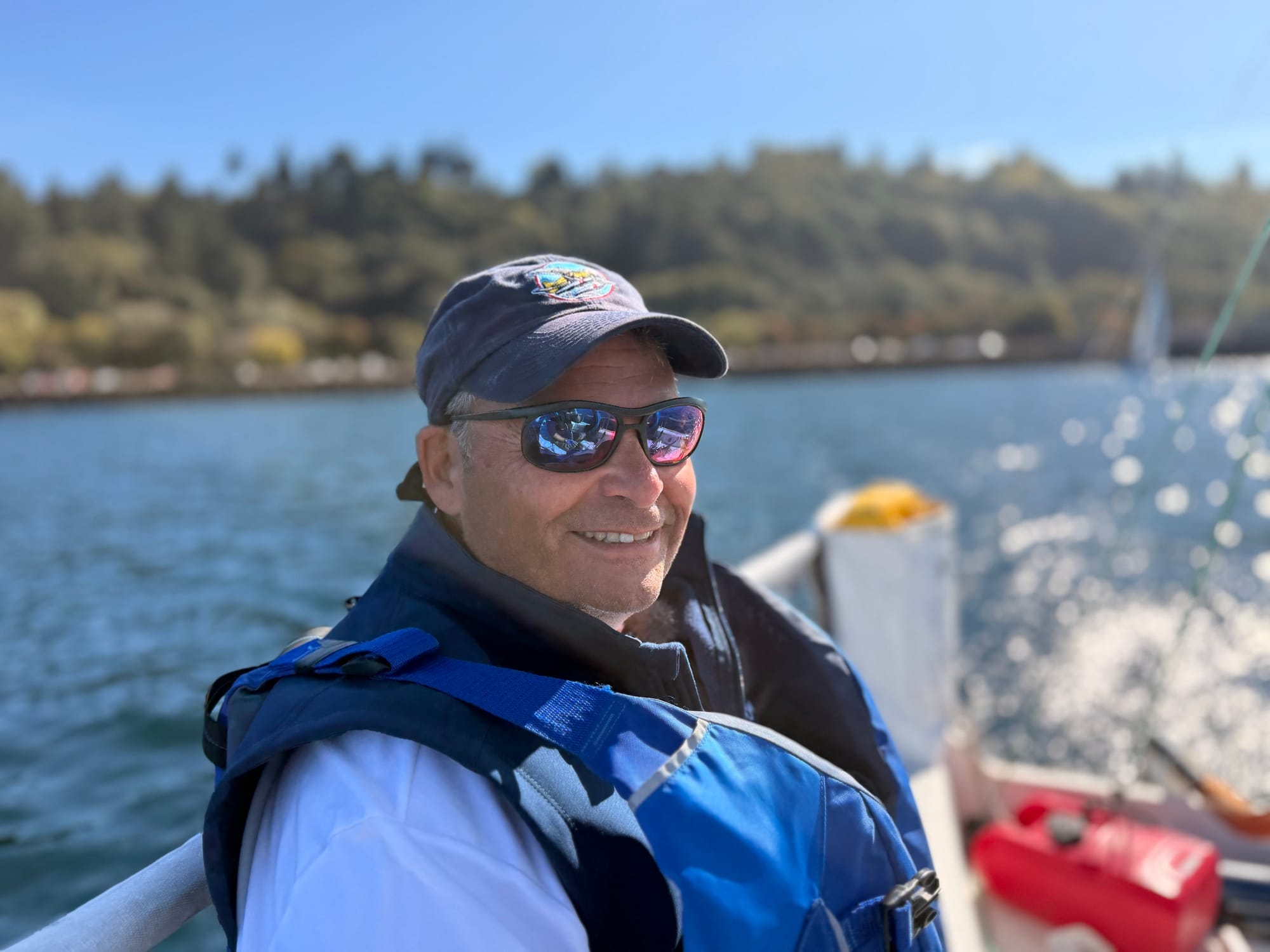
Day 4 - North U Performance Race Week - Tactics and more starts
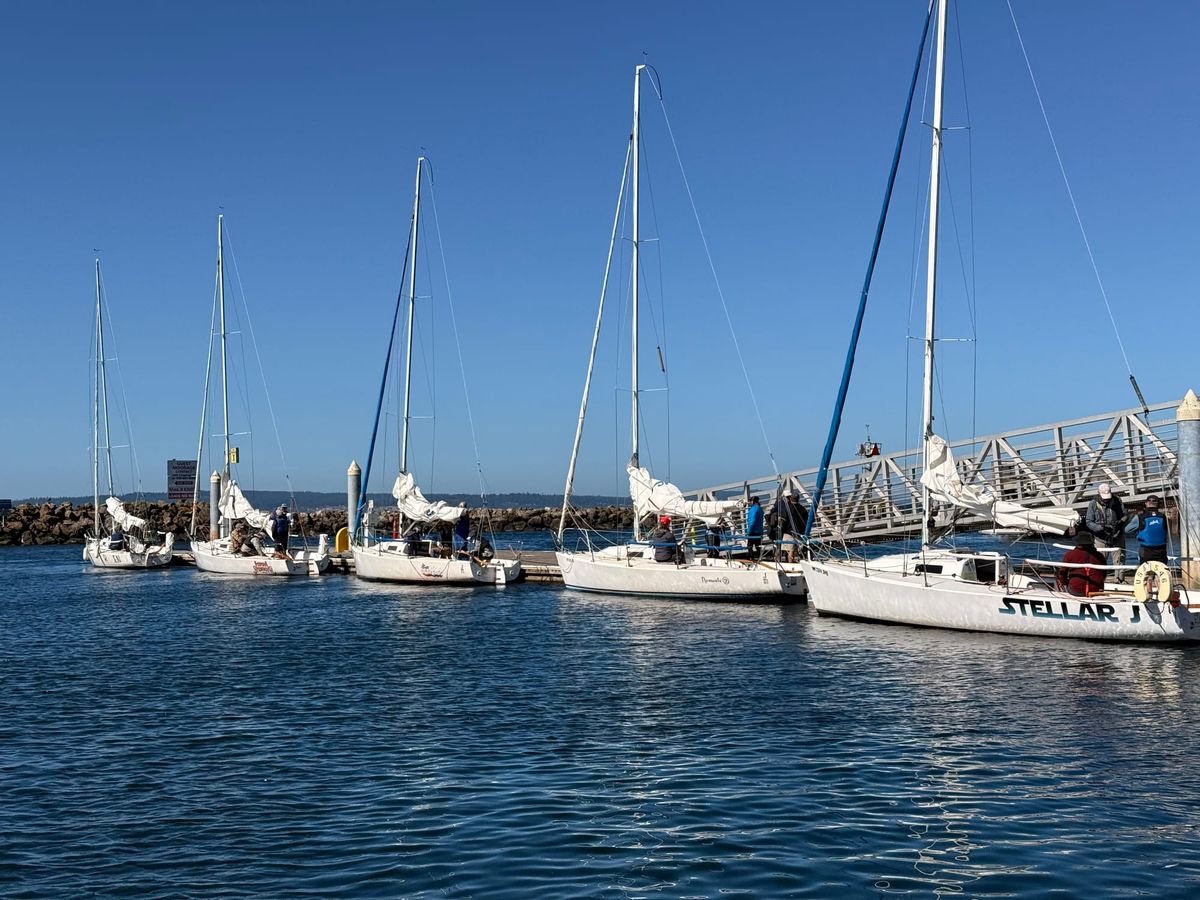
What another beautiful day in the Northwest. Thursday brought a bit more breeze, and we made the most of it. We started in the classroom, unpacking lessons from the day before and digging deeper into tactics. The focus was on starts, mark roundings, and especially how to defend the right or left side of the course. A big theme was fleet awareness: it’s easy to get locked into a one-on-one duel, only to look up and realize the rest of the fleet has gone to the favored side. Beating one boat doesn’t mean much if ten others just sailed around you. The constant reminder was simple but true—boat speed is your best friend in all conditions.
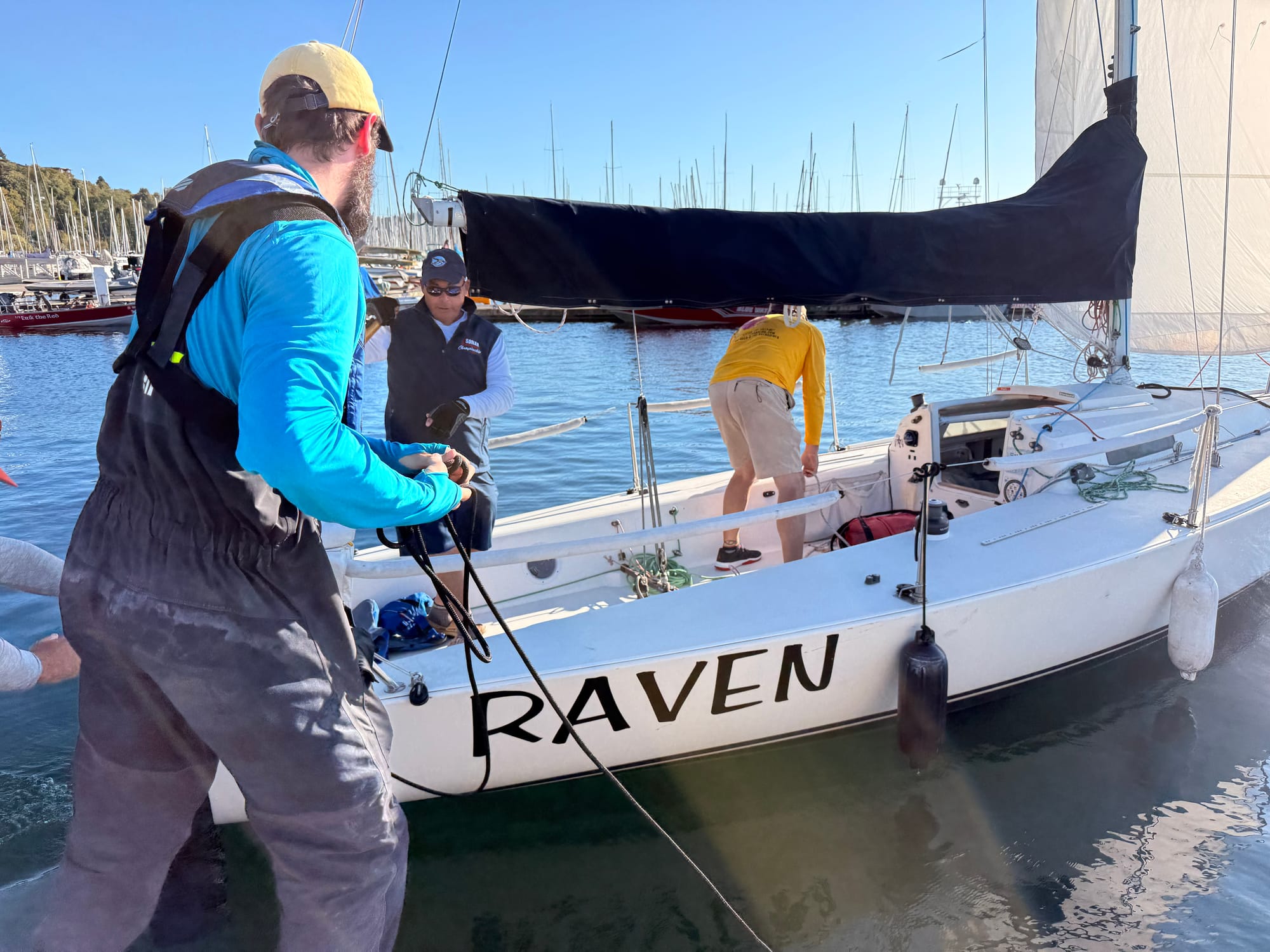
On the water, we put those ideas into practice. We worked through multiple starts and tactical drills, protecting lanes, managing neighbors, and practicing “winning our neighborhood” without losing sight of the bigger picture. The breeze held nicely, and we had a couple of very solid practice races—great starts, good beats, clean roundings, and finishes near the front of the group. It was a satisfying day of steady improvement, with plenty of small lessons in boat handling and positioning adding up.
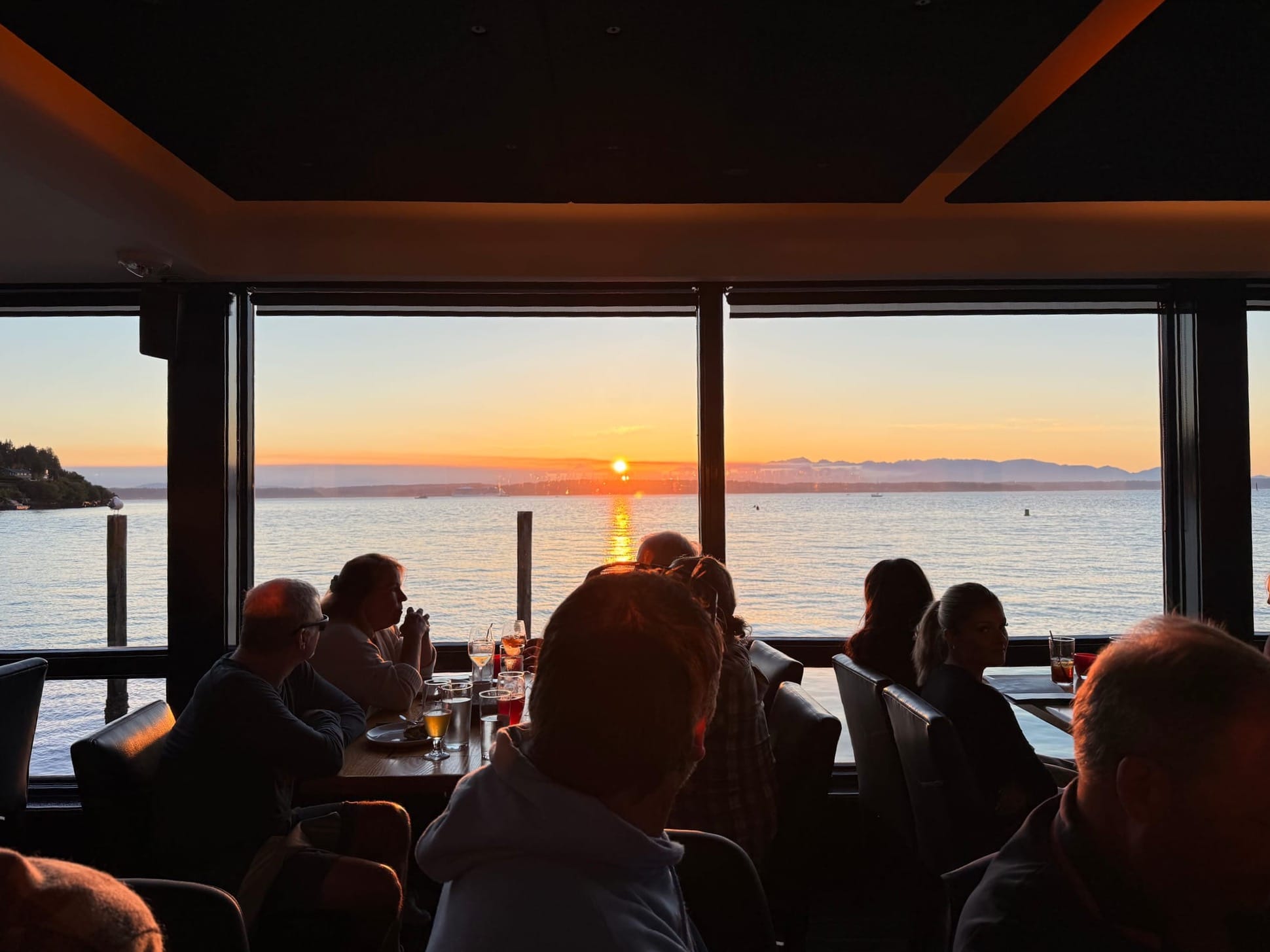
After wrapping up, we had a short debrief with Terry before heading ashore. I spent some time at King’s with Tory and Scott, then made my way back to Ray’s for “Take Your Coach to Dinner” night. We sat with the crew from Symmetry, and I had a fascinating conversation with Coaches Bobby and Terry. We compared notes on the big-boat classes (1D48s, TP52s, RC44s) and the smaller ones (Melges 24s, J/22s, J/24s, J/70s, J/80s). The range of perspectives was eye-opening. Terry even shared stories from his ice-boat racing in the Midwest—an entirely different world, but one that shares the same obsession with speed, balance, and reading the elements.
the "Shaggy cut" of sailing from Wednesday
Thursday AM — Strategy, Starts, and Situational Tactics
Forecast & Day Plan
- Used high-res models to time the breeze: HRRR (sub-hourly, ~15-min steps) favored for today; HRRR-48 and NBM (“the Blend”) for 48–106 hr outlooks. GFS is broad but weaker on local effects (e.g., seabreezes).
- LuckGrib is an awesome Grib viewer - downloaded that and figured out how to use it.
- Big tides: expect noticeable current differentials (shallows show slack first). Plan was to sail the same Meadow Point course once the breeze filled.
Current + Start Line Effects
- Adverse current (pushing you back from the line): stay closer to the line; tacking tends to advance you up-current more reliably than jibing in pre-start.
- Pin-favored (line angled upwind at the pin): easy to be late if you wait downcourse—stay high/near the line so a final starboard tack still reaches.
- Boat-end favored (committee boat set upwind): easy to be early; many rush in, realize too late, then reach down the line—hang back, let them slide, then enter at speed.
- On-the-water tells: committee boat flag angle/swing, “sail the line” sanity check (on starboard to pin you’re easing a lot in a right shift; main/gennie act like a giant windex).
Rules & Risk Management (pre-start)
- Speak precisely: it’s Windward/Leeward (Rule 11), Keep Clear, Room & Opportunity on new overlaps; no “proper course” before the start signal (Rule 17 applies after).
- Barging: the committee boat is an obstruction; windward must keep clear. High-percentage move is avoid contact, wave them through, then protest—don’t trade a hole-in-boat for a point.
- Don’t get stuck fighting one boat: the fleet sails away while you box.
Pre-Start Plays & Defense
- Scooping (anti-hook): if a stern boat tries to establish leeward overlap, bear off early across their bow to deny overlap; if they chase, they over-rotate and must head up—tables turned.
- “Max Gap Left” (to windward): luff main in / jib eased to pivot up without accelerating and build a windward buffer for a clean punch-out.
- To accelerate hard: ease main / trim jib to move CE forward and bear away.
- Managing your leeward hip (Gap Right): you can compress the windward gap to gas the boat on your hip, but don’t fixate and miss your own trigger.
- Port-approach option at boat end: come in on port to the starboard-tack layline, tack onto it, then time-and-distance your final luff/hold/launch. Cleaner than “lurker” if the pack is messy.
- Lurker approach: hang back while the front row gets early/slow, then reach in at full speed and tack. Higher risk if they weren’t early—can leave you 2nd row.
Time & Distance
- Build a repeatable map (time hacks → positions). Use instruments (e.g., Vakaros) or practiced ranges to pair timerwith time-to-line and keep the bow sweeping up in the last 10 s.
Priority & Mindset
- Default when unsure: low density, clear air, full speed—then let the race come to you.
- After the gun: whole crew supports boatspeed first—stable heel, crisp trim cycles, wind calls; driver locks into mode while tactician looks for the first shift/pressure.
Thursday AM — Mark Lara on Wind & Local Conditions
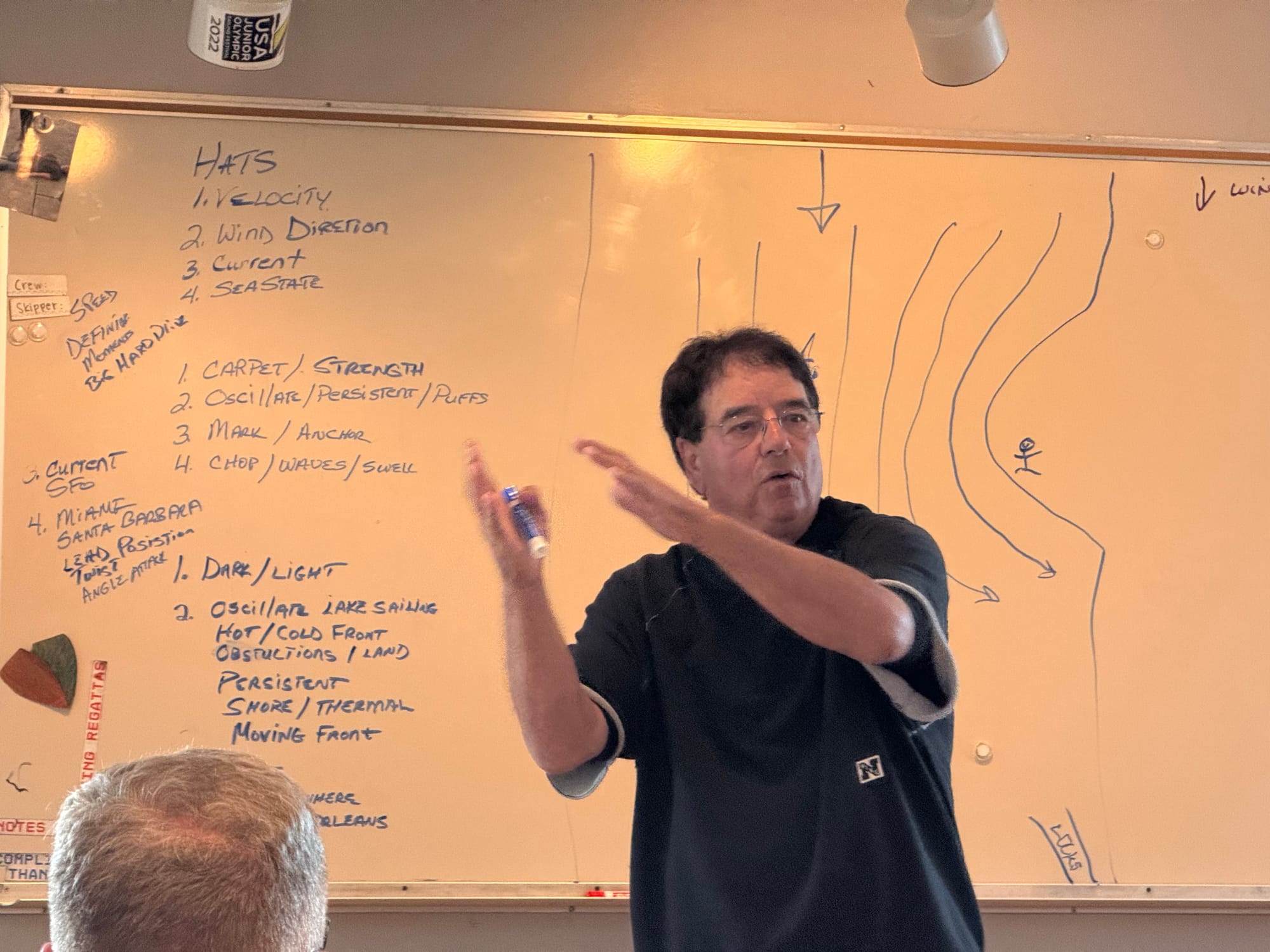
Big idea: Master the controllables (prep & boat speed) and use a simple, repeatable framework to read velocity, direction, current, and sea state. Strategy/tactics sit on top—but without speed and clean handling, they won’t save you.
Pyramid & “Defining moments”
- You control: boat prep (rig, weight, bottom) and boat speed (trim, heel, modes). Do these relentlessly.
- Races hinge on a few defining moments (e.g., boxed in at the wrong end, missing layline in current). Aim to minimize losses more than “hero” gains.
Four lenses for any venue
- Velocity (pressure): Look for the darker/glossier water (“carpet”). Many top sailors race pressure first.
- Wind direction: Track small chop orientation and lanes to see lift/head trends; your home venue biases how you “see” this—stay objective.
- Current: Read anchor rodes, buoys, shoreline flow. Slack shows first in the shallows and works outward. Expect micro-seams and back-eddies.
- Sea state: Here it’s driven by wind vs current alignment (same direction = flatter; opposing = choppier). Flatter near shore; lumpier in deeper water.
Shifts: how to classify and use them
- Oscillating: Rhythmic back-and-forth. Work the ladder rungs—tack on headers, ride lifts.
- Persistent: Marching one way. Get to the advantaged side and stay leveraged.
- Oscillating-persistent: Take the oscillations while trending to the “big side.”
- Puffs: Short, fan out on contact; your side of the puff determines lift vs header—adjust trim/angle quickly.
Seattle/local playbook (Ballard breakwater → Meadow Point)
- Geographic lifts at points: Wind and current both bend around headlands; expect a lift when you approach, and again after you tack away.
- Flood vs ebb:
- Flood (today): Current and wind likely both N→S; flatter water. Expect accelerated flow near the point and seams along the wall. Inside may turn first; outside grows stronger later.
- Ebb: Often more pressure outside, but weigh it against adverse current and sea state.
- Right side generally strong with northerlies, especially when true wind is 360° or right of it; with ~310° NW, left can pay if it clearly shows more pressure.
- Rule of thumb: About 2/3 of the time the shore/point route pays here; 1/3 the time outside pressure wins. Keep validating—don’t hard-code it.
Starting & first minutes (ties to yesterday)
- Default when uncertain: low density, clear air, full speed.
- Plan your zone at go and work backward (time & distance). Protect lanes that let you execute the side you want (today: protect the right).
- On line mechanics: minimize gap to right, maximize gap left, avoid overlaps so you control your destiny.
Quick on-water checklist
- Before sequence: Identify visible pressure corridors, note current seams (shore first), pick primary side; brief “if/then” for a big shift.
- During sequence: Run the line twice (starboard→pin, tack back) to confirm line square and shift; watch trimmer’s ease/trim as a proxy for shifts.
- Off the line: Sail fast first; take the early geographic lift toward the point, re-check pressure vs current; don’t miss the second lift after the tack off the point.
- Laylines: Expect effective layline to move with current accelerating near the point—re-aim sooner.
Today’s emphasis: Boat speed fundamentals plus “protect the right” drill within the natural boundary (breakwater/swimmers). Eyes out of the boat; keep reading pressure, direction, and current continuously.
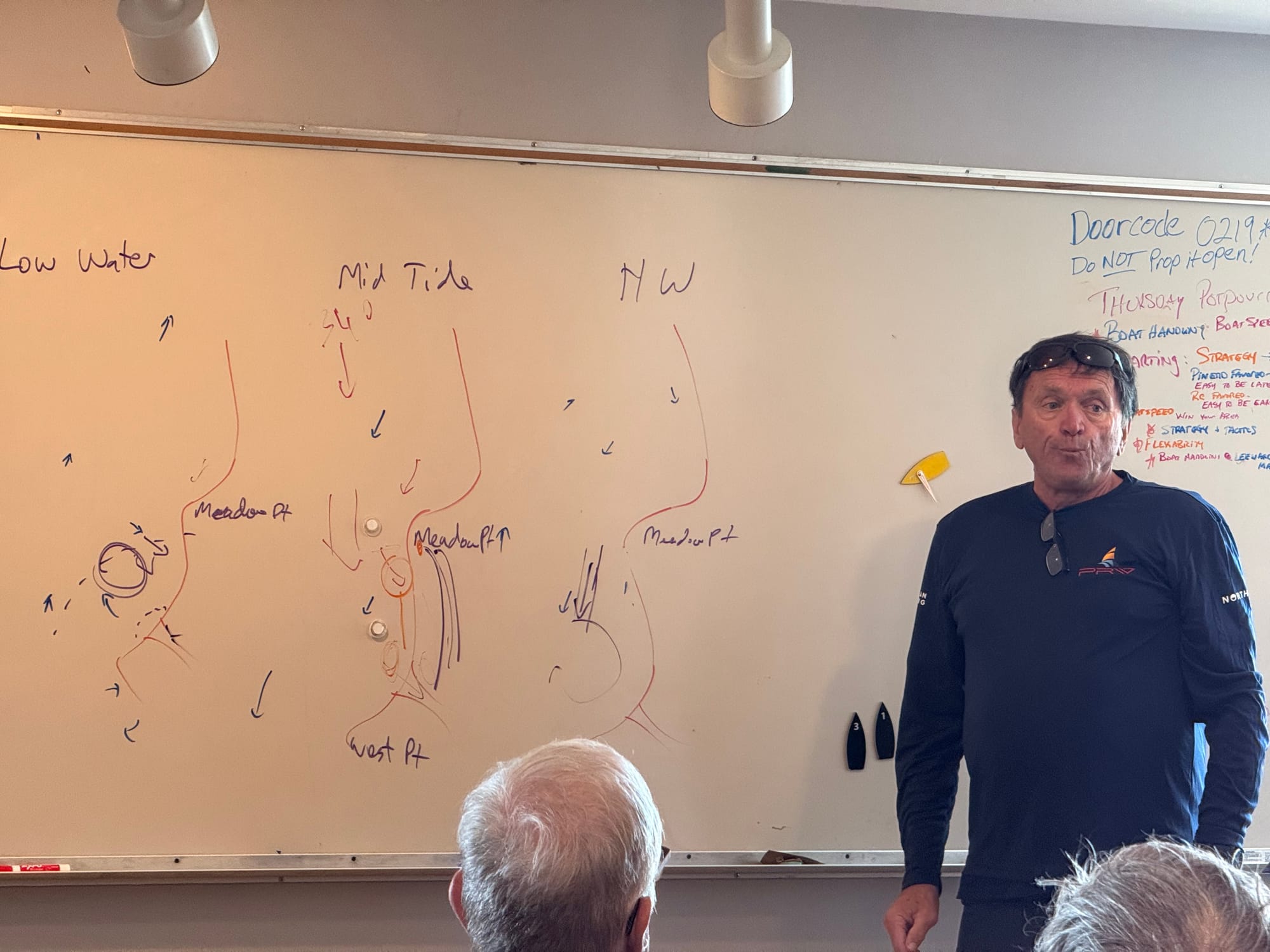
Steve — Local Currents: Practical Playbook
How the tide actually “turns”
- Turns at the shores first, then works its way out to deeper water.
- Momentum lingers: expect ~1–1.5 hours of continued flow after posted high/low before the bulk of the basin reverses.
- Mid-tide “transition” produces mixed signals (back-eddies, seams, uneven strength).
Where it flows (and stalls)
- Headlands/points compress and accelerate flow; shapes of the hillside/shoreline funnel water and wind (thermal effects can add to this).
- Walls/breakwaters create wind shadows and dead spots; current can still run while the wind “dies” in the lee.
- Expect back-eddies inside turns and around rounding boxes—think of them like a roundabout: flow curves and re-enters.
What to look at on the water
- Surface clues: “chocolate/darker” rough water often marks stronger current; smooth may be wind shadow (or less current).
- Debris/tide lines: floating trash/grass reliably trace the seam—we saw clear lines near the start and up by Meadow Point.
- Anchors/ropes/buoys: quick reality checks on direction/strength.
- Freshwater inputs (locks/river runoff) can shift the pattern seasonally; this year outflow is low, so salt-tide dominates.
Wind vs current — which to value?
- Local rule of thumb shared: ~1 knot of current ≈ ~5 knots of wind (very rough VMG tradeoff).
- Use this to sanity-check decisions when local says “current” but your eyes see much more pressureelsewhere.
- Example: at times, extra breeze beat the near-shore relief.
Practical race implications
- On flood: expect acceleration along the point; inside may show the turn earlier, outside can stay stronger longer.
- On ebb: stronger set outside; weigh it against sea state and lane quality.
- Laylines move with current—re-aim early near compressed flow at the point.
- It’s easy to misread dark water as wind when it’s current (and vice versa). Keep validating with multiple tells.
Quick tie-ins from the tactical segment that followed
- Four classic options when you’re crossing near starboard layline:
- Immediate lee-bow (powerful only with enough runway; risky if close to layline).
- Cross–tack–pin (cross, tack to weather, control to the layline).
- Delay then tack to a safe position (2–3 BLs past, preserve options/avoid over-commit).
- Bail early if you’re getting lee-bowed near the mark; don’t trap yourself short of layline.
- Fleet management: win your neighborhood first; you can “herd” packs by lee-bowing the front boat to slow the train.
- Afternoon drill focus: three start sets + W/Ls; protect your breeze downwind and expect course bias (more time on one tack by design).