Day 3 - North U Performance racing Week
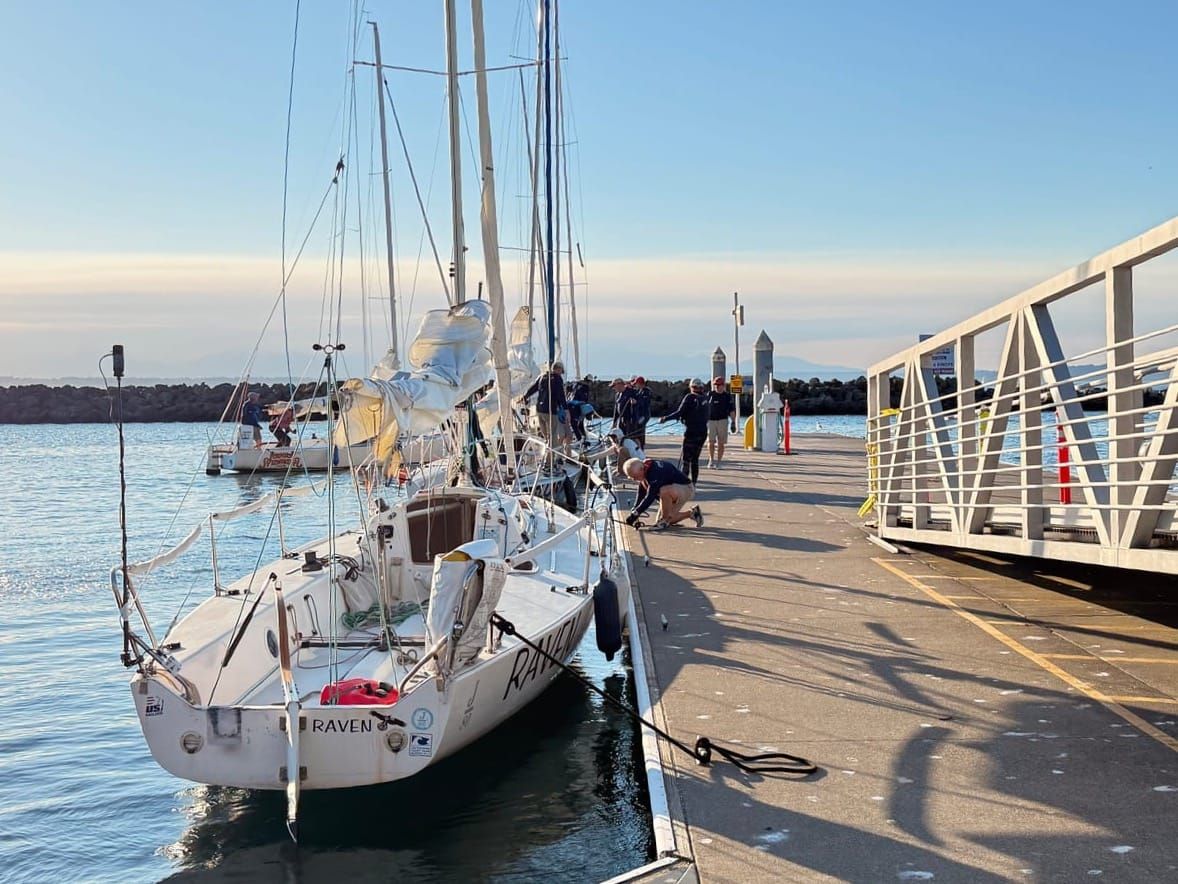
Wednesday – Focus on Starts
With no wind in the morning, we didn’t get out on the water until mid-afternoon. Even then, we had to rock the boat out of the marina before the breeze began to fill. Once outside, though, conditions improved, and we were able to run a series of practice starts.
The format was a fifteen-minute sequence. The first two five-minute rounds were short practice starts between the coach boat and the Ballard sail buoy, followed by a 50–80 second upwind sail to compare our performance against the other boats. On the third sequence, instead of stopping, we continued racing to Meadow Point, hoisted the chute, and sailed back down to the coach boat. We cycled through this roughly five times, rotating crew positions each round.
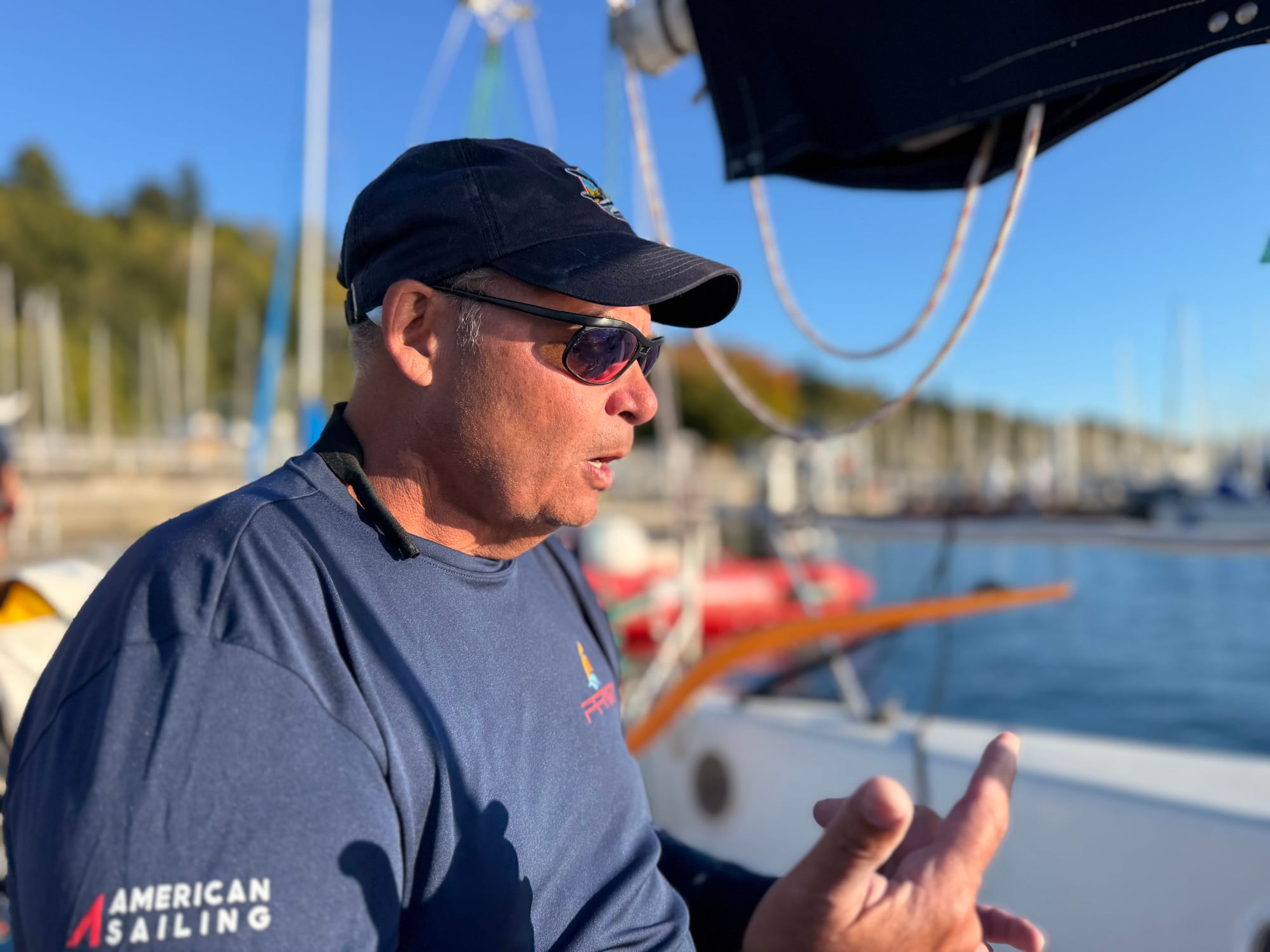
Our onboard coach, Terry, introduced us to “The Swirl”—a counter-clockwise rotation along the start line, like a game of musical chairs. The pattern: sail down the line on starboard, gybe at the pin, sail just below the line on port toward the committee boat, tack back onto starboard, and repeat. The idea is to work backward from your desired start sector—Sector A (boat third), Sector B (middle third), or Sector C (pin third)—and position yourself in the swirl so you’re exactly where you want to be at the gun. The keys: on time, on the line, at 110% target speed, with clear air and a clear lane.
Terry emphasized that overlaps during the swirl kill your options. If another boat establishes overlap, you lose the ability to control your own destiny. His constant refrain: fight to break every overlap.
He also brought along his Vakaros instrument to demonstrate. It was impressive—precise timing, distance to the line, time to burn, and acceleration cues. It made hitting the final 10 seconds with confidence much easier. And on top of that, it automatically logged all the performance data I’ve been trying to capture with the Raspberry Pi—only cleaner and better.
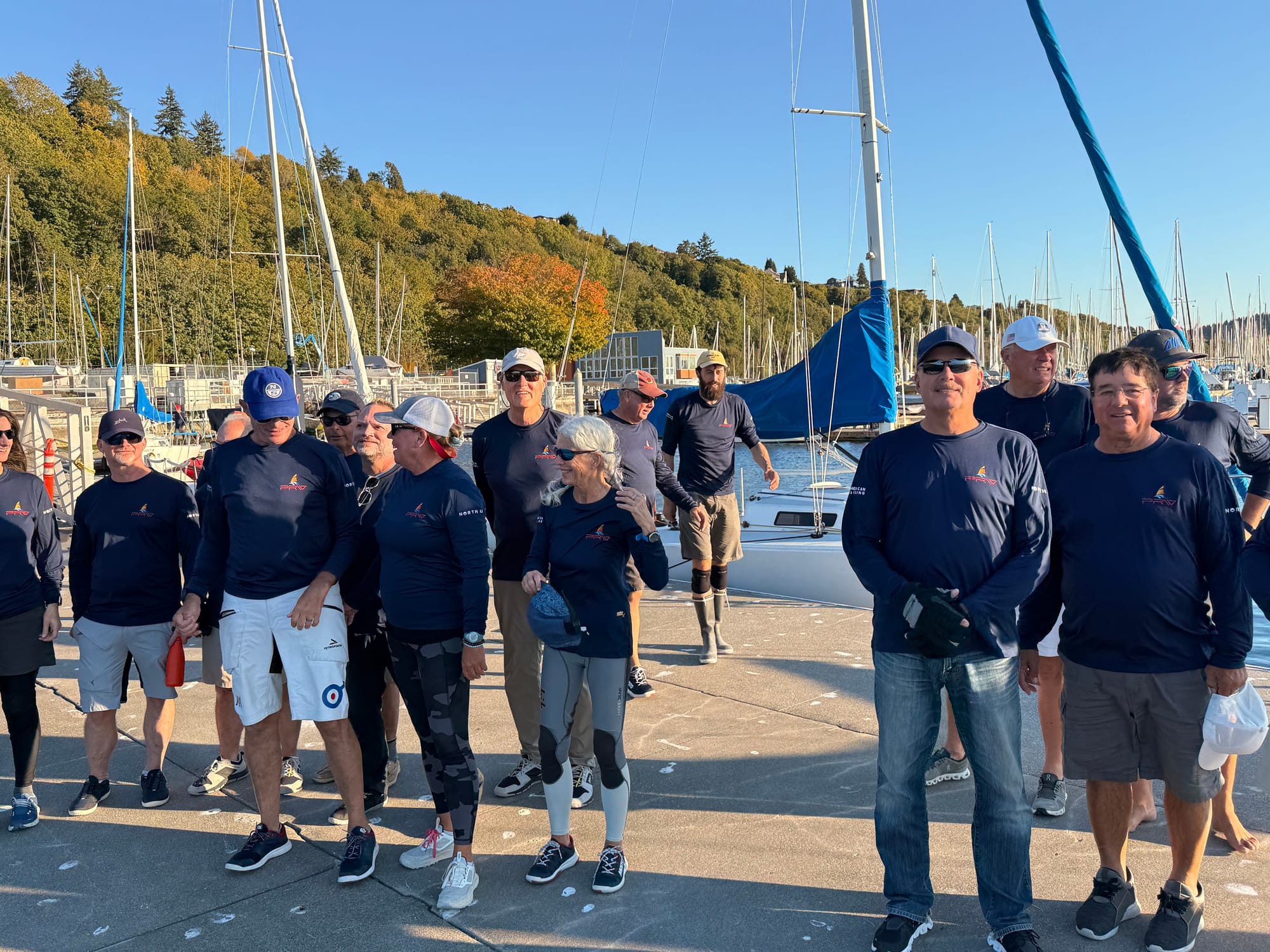
The day ended with us all lining up on X dock in front of the boats in the dying light, and KB getting a picture of us all in our course shirts.
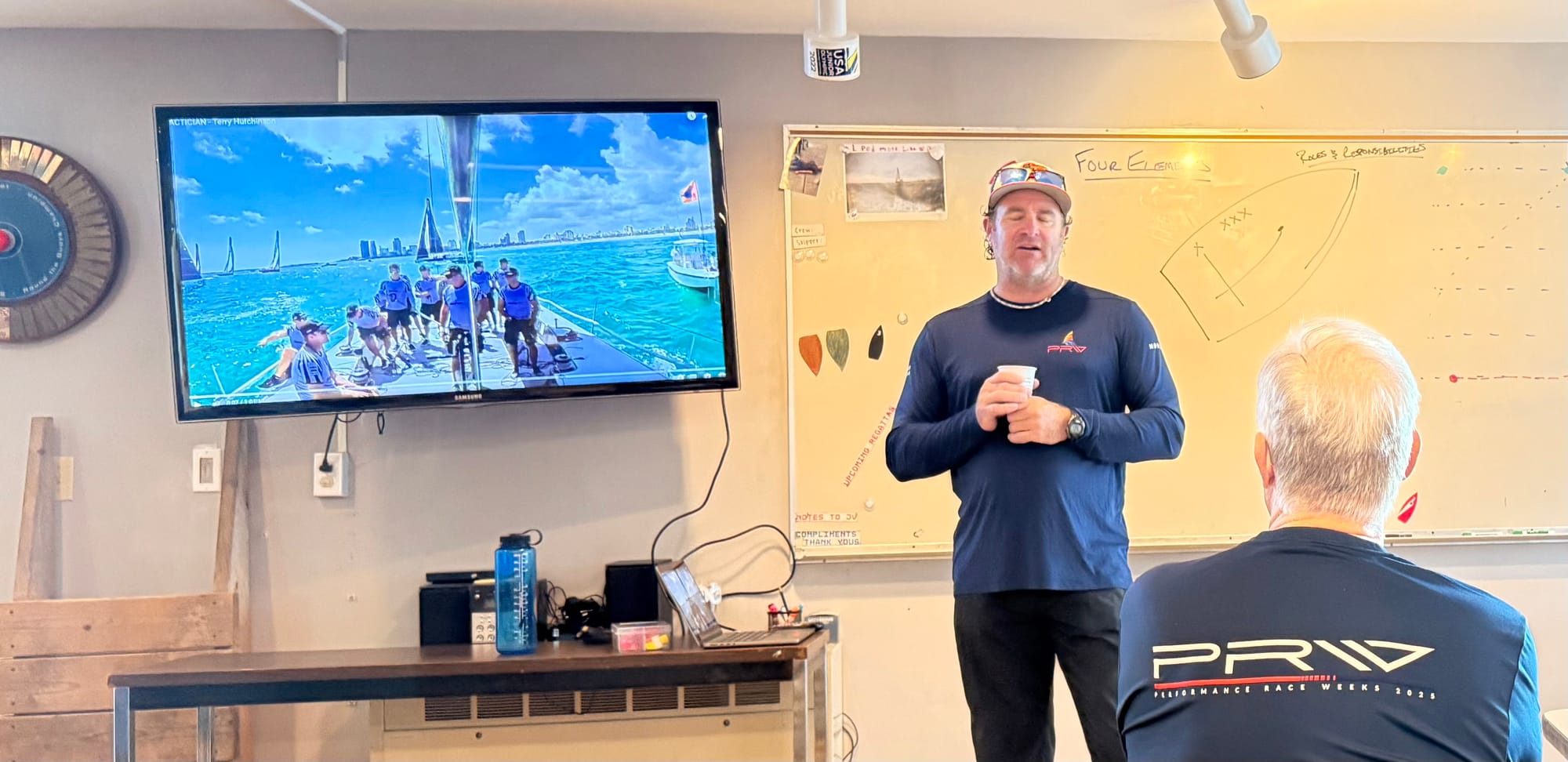
Below is the notes from the morning lecture sessions.
the NorthView performance pyramid — preparation → boat handling → boat speed → strategy & tactics — and how this week we’re moving along that path.
We focused on starts as a means to an end. A start is important, but you still have a full race leg afterward; good starts buy you options up the first beat. Race committees size courses to expected boat speeds, so marginal gains matter — at world level the difference from 1st to 100th can be ~2% of time.
We watched a Terry start video and unpacked it. Key lessons:
- The conversation in the boat was ~90% environment/course and ~10% other boats — treat other boats as speed bumps, not the race.
- Start discipline: practice runs, time/distance planning, and a reverse-engineered “lily pad” of where we want to be at each time check.
- Use landmarks, sync your watches to the committee, and use a “magic box” (time/distance instrument) if available.
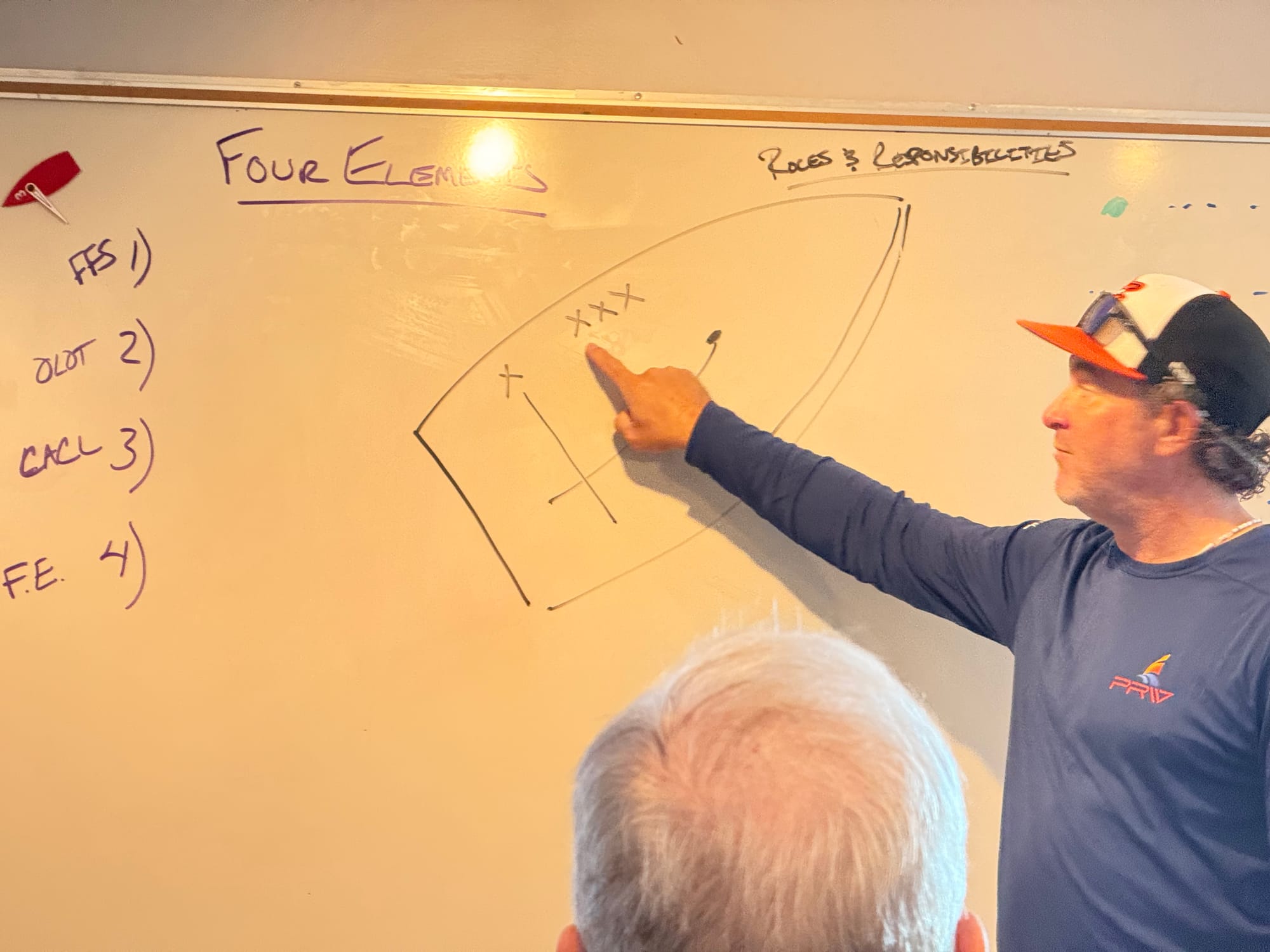
Roles & responsibilities (concentric circles):
- Forward crew: upland/lookout and early environmental calls.
- Middle crew: relative performance, time calls, and wind/boat comparisons.
- Main trimmer: central computer — processes inputs and makes setup decisions.
- Helm: executes the last 60 feet; steers the bow sweep and controls the final 10 seconds.Shared leadership is ideal: one person sets the global objective and each role knows the action required to execute it.
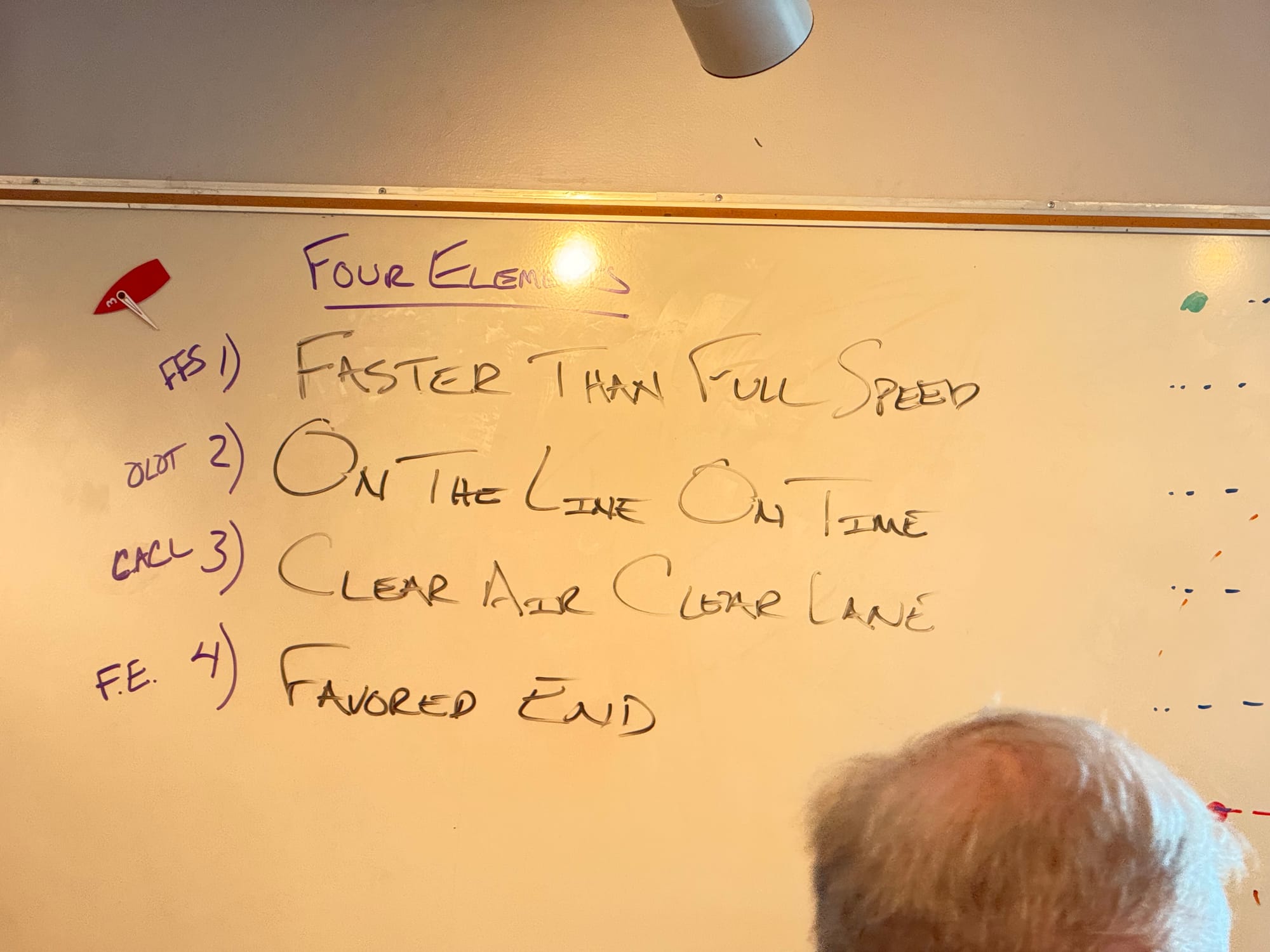
The 4 elements of a perfect start (the “4x4” we’ll practice):
- On time / on the line (0 sec / 0 meters).
- Faster than full speed (target ~10% above normal upwind speed through the water).
- Clear air / clear lane (avoid others’ wind shadows).
- Favored end — pick it if it matters (but prioritize the element most likely to win the leg).
Tactics & techniques covered:
- Half-tack: a useful tool — tack without releasing the jib to alter position or scrub speed safely in these boats.
- Bow down technique: small forward weight and trim changes to accelerate high into the line.
- Time calls: start time cadence (every 30s from 5→1min, every 10s from 1→0.3min, every 1s from 30→0) and reverse-engineering your approach from where you want to be at 0.
- Musical-chairs approach for pre-start positioning (moving along the line to gather data and pick your launch lane).
Pre-start reconnaissance:
- Sail down the line at half speed to measure time/length, trim as you go, and use that to calibrate where you need to be at each time hack.
- Trimmers should sail up/down the line and use sail trim as a wind sensor — sail trim movement is often the first indicator of a shift.
Communication & mindset:
- “Quick eyes” — look at sail shape, make a diagnostic fix, then immediately scan for wind opportunities. Never waste moments.
- Use calm, impartial calls: report the fact (“we’re lower, same speed”) then add a value statement (“net gain for us”) so the team knows how to act without emotion.
- Shared model beats a single voice shouting — keep the helm’s bandwidth focused on steering.
Practical boat work we discussed and will practice:
- Sail controls and traveler zeroing for predictable mainsheet behavior on tacks.
- Spinnaker sets & douses: luff vs. weather vs. jibe douses, “schwabble” to depower before the douse, keep halyards/tack lines clear, and do housekeeping (sheets, tackline) before you approach the mark.
- Trim positions for reaching vs. running, how to detect front vs. trailing edge collapse on the kite, and the role of body position to prevent sheet fouls.
Numeric example to remind us why choices matter:
- Two upwind boats at 6 kt, separated laterally: a 10° shift can deliver ~212 ft (≈21s) advantage to the boat on the lifted side — small wind moves = big gains.
Logistics & format:
- We split into short rotating mini-classes (25 min each) led by coaches on mainsheet trim, crew weight/communication, spinnaker sets/takedowns, tactics/strategy, local venue tips, etc. We’ll hit most topics across the week.
Takeaway actions for me / the team:
- Practice the 4x4 start repeatedly (reverse-engineer where we should be at each time hack).
- Monitor and practice small, repeatable sail-trim changes while moving up/down the line so trimmers become fast wind sensors.
- Clean up on-boat housekeeping (sheet management, tackline clearances) — fumbles cost results.
- Keep communications factual + value statement; pick one person to call time and distance.
Overall impression: excellent practical framework and process for improving start-up and pre-start decision-making. We’ll rolled these into the on-water drills in the afternoon and practiced the half-tack, time/distance execution, and spinnaker handling under realistic conditions.