Day 2 - North U - performance racing week
Another glorious day of learning how to sail - this time for boat speed, boat to boat tuning, and rabit starts for fleet tuning. Group dinner at the club house rounded out the day.


We spent the classroom time sharpening the “process over heroics” mindset: build playbooks, communicate in advance, and sail in the right mode—push vs. pull—while managing the three levers of speed: angle of attack, draft, and twist. We focused on sailing by feel and heel, watching leech telltales, and using backstay/forestay sag and jib halyard in the right order (backstay as the big knob; halyard to park draft). The goal stayed simple: keep flow attached, keep the boat accelerating, and call our relative performance clearly (“higher/faster—net gain us”). “Quick eyes”: glance shape, adjust, then scan for the next puff.
On the water it was gorgeous—calm morning light and a pod of orcas cruising by put on a show. We worked boat-speed fundamentals and more boat handling; execution was good with obvious room to polish. Our boat-on-boat tuning paid off—we could really see how small trim changes moved the needle. In the afternoon we ran rabbit starts (great reps), nailed a couple of launches, and won the informal drag race to Meadow Point. The wind faded to light and flukey later, which made the finesse work even more relevant. After the post-race debrief everyone sprinted home for a quick shower and then back to CYC at 6:30 for the group dinner—nice chance to meet more sailors and chat with a few coaches.
Pre-Day Briefing — Boat Speed & Sail Trim (key points)
Theme & Big idea
- Primary focus: keep the boat moving fast — speed kills (i.e., speed beats clever tactics).
- Two essential traits of elite sailors: constant curiosity (high change-rate of small adjustments) and pattern recognition (higher bandwidth).
- Priority: learn to see & prioritize the few controls that actually change speed (don’t fiddle the tertiary stuff first).
Vocabulary & common language
- Use shared names for sail corners and edges: head / tack / clew, luff (leading edge), leech (trailing edge), foot.
- Talk in shorthand so communications are quick, accurate and positive.
Two modes of sailing
- Pull (flow) mode: air stays attached from luff → leech; lift/drive produced by attached flow across the cambered foil. Use when you want efficient drive (most upwind and reaching).
- Push mode: sail acts more like a parachute (wind pressure on windward side); dominant when sailing very deep/downwind.
- Transition indicator: when apparent wind in the boat “dies” (slows or shuts off), you’re moving toward push; maintain attached flow during transitions. Err on undertrim rather than overtrim when uncertain.
Three sources of power (what to manage)
- Angle of attack (AoA) — sheet/traveler/helm choices; determines whether sail is filling or stalled.
- Draft (depth & position) — how cambered the sail is and where the maximum depth sits. (Deeper for light air, flatter for heavy; draft position matters.)
- Twist — difference in AOA from foot → head (controls heel & how top behaves). Twist is critical in light and heavy air and follows a bell curve: lots of twist in very light, flatten in medium, re-introduce twist as you depower in strong winds.
Practical sail controls & what they do (high-leverage guidance)
- Halyard: primary for draft location (upper half of sail).
- Cunningham / anti-halyard: influences lower-half draft placement.
- Main sheet: primary twist control upwind (pulls boom down when sheet is loaded); transitions to AOA control as you bear away (boom nod marks that transition).
- Traveler: primary AOA control upwind (use traveler to change exit angle and keep boom centered).
- Vang: pulls boom down → twist modifier, especially important reaching/downwind. Set vang baseline so it engages as sheet goes out.
- Backstay: flattens mains & tightens forestay (moves draft forward, affects jib power). Powerful, frequently used; not binary — stay in middle of range unless conditions demand extremes.
- Circuit thinking: traveler ↔ sheet interact — don’t let one top out without readjusting the other.
Trim cues & telltales
- Leech telltales are crucial. Watch trailing edge—detachment at the leech is an early stall indicator.
- Look up and out (chin up sailing). Where the crew/helm look reveals priorities.
- Test luff: a little luff is normal; the click-click temptation to pull more can push you into stall.
Boat balance
- Center of effort (sails) vs center of lateral resistance (hull/keel) — alignment controls helm balance.
- Heel changes both centers, producing turning moment; small changes matter (nibble & test).
- In some conditions, heel to weather can help steer straight without rudder.
On-water habits & mindset
- Elite behavior = many, small, accurate adjustments (high rate, low range).
- Controls have ranges — operate in the middle; extremes usually mean rig/tune is wrong.
- Prefer small nibbles over big corrections. Communicate priorities: which control to change first (traveler before fiddling with halyard, etc.).
- Use video: phone + cage is one of the best coaching tools (record drills, review).
Quick actionable rules to use today
- Keep boom on centerline for close-hauled baseline; then adjust traveler and backstay to tune power/heel.
- When uncertain, ease slightly then test—undertrim reattaches faster than overtrim.
- Set leech telltales on main & jib; use them continuously.
- If traveler is at top of range, pull it down and sheet in to stay in working range.
- Backstay demo: expect large mast bend; use it to flatten and move draft forward.
- Observe the boom “head nod” — that marks the sheet → traveler transition zone.
- Scan loop for helms: landmark/horizon → telltales → feel through hips.
Plan for the day
- Morning: fundamentals of sail trim and boat speed; on-water practice to put it into effect.
- Lunch: deeper breakout and analysis.
- Coaches released to boats — expect focused drills and video coaching.
Lunch Debrief — Boat Speed, Communication & Afternoon Drills
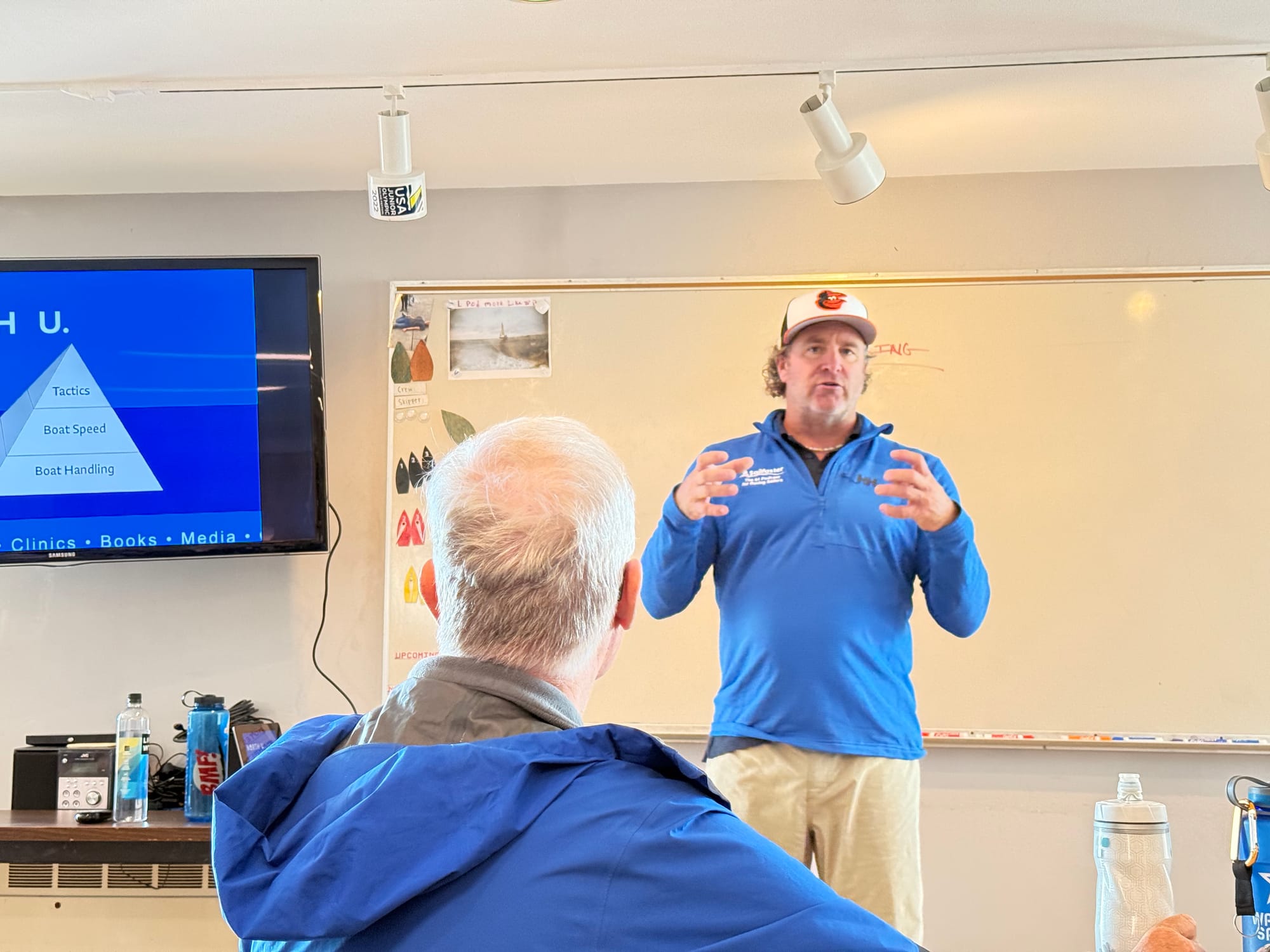
Morning Recap
- Extended sailing session was worthwhile; some groups even spotted orcas and volcano views — a reminder of how distracting beauty can be when trying to sail straight.
- Teams successfully ran two-boat lineups, which are critical because:
- Sailing alone always feels fast.
- Only side-by-side testing reveals true speed/angle performance.
- Pairs allow instant feedback on trim/setup changes.
- Afternoon will expand from pairs to fleet-level testing.
Video Example — High-Functioning Team Upwind
- Jib trimmer was the lead communicator; constant updates on relative performance.
- Key calls: “higher/faster,” “same speed,” “lower/faster.”
- Style:
- Always framed in terms of “we/us”, never about “them.”
- Reports were factual + value statement (e.g., “We’re lower faster, net gain us”).
- Delivered without emotion — no negativity when reporting bad modes.
- Clear identification of which boat being referenced (switching targets explicitly).
- Crew added environmental calls: puffs, lulls, headers, waves.
Roles & Responsibilities (4 universal positions)
- Forward crew — transitions, looks ahead for breeze/waves, counts puffs.
- Middle crew (e.g., jib trimmer) — responsible for boat speed + relative performance.
- Main trimmer (“central computer”) — processes inputs, makes balance calls, leads decisions.
- Helm — drives with narrow focus (telltales & horizon); communicates when the boat feels balanced or off. Helm is not “God” in modern models; relies on team feedback.
Communication Takeaways
- Information must be constant: great teams are never silent.
- Each crew speaks only within their lane, which makes the “symphony” coherent.
- Emotional delivery (e.g., “low and slow” with frustration) is unhelpful; must stay neutral.
- Add why/next step when useful (e.g., “We’re slower, but net gain to leeward” → adjust accordingly).
- Observing competitor setups (jib lead, sheet tension, crew position) adds valuable context.
Steve Hunt’s “Need for Speed” Insights
- Light air: steer by telltales, crew moves weight aggressively to keep flow attached.
- Medium air: transition mode; skipper begins sailing more to heel angle, inside telltale can lift.
- Heavy air: fully overpowered; skipper feathers to maintain heel; trimmers depower actively.
- J/80 sweet spot: 12–15° heel in most conditions (upwind or downwind).
Trim & Steering in Waves
- In lumpy water, main trimmer plays sheet/vang actively to smooth motion and keep speed constant.
- Helm steers only as much as necessary: small, accurate adjustments beat “sawing.”
- Grip choices:
- Frying pan grip (steadying tiller against deck) works for straight-line speed.
- Microphone grip into thigh provides both steadiness and full articulation.
Elite Program Examples
- World Championship J/80 footage:
- Active mainsheet + vang sheeting, boat always in forward mode (fast-forward bias).
- Goal: high baseline speed first, then climb when needed.
- Daily debrief slides: pro teams track rig settings, crew positions, sail shape, wrinkles (overbend wrinkle as indicator of max depower).
- Photo analysis: use consistent on-water shots to compare setups over time; practice pre-race to lock in base trim.
Calibration & Tuning
- Guides (e.g., North Sails) = starting point, not gospel.
- Teams must build their own tuning matrix (rig tension, traveler, vang, jib car, etc.) tied to wind ranges.
- Treat sailing like cooking, not baking: start with recipe, then adjust seasoning for conditions.
Afternoon Drills
- Upwind Rabbit Start Drill
- One boat (“rabbit”) sails close-hauled on port.
- Others duck on starboard, lining up side-by-side.
- Goal: 3–5 minutes of same angle/faster relative testing.
- Rotate rabbits until all boats get the role.
- Coach boat takes transom photos for trim comparison.
- Downwind Scramble Drill
- Coach boat leads a hotdog course (beam reach box).
- At whistle: lead boat rounds, sets kite, fleet follows sequentially.
- Line up downwind, jibe together on whistle.
- Goal: maximize VMG and lane-holding, not tactics.
Target: First rabbit lineup at 14:15, return to classroom by 16:15.
Post-Day Debrief — Light-Air Setup, Cues, and Lessons
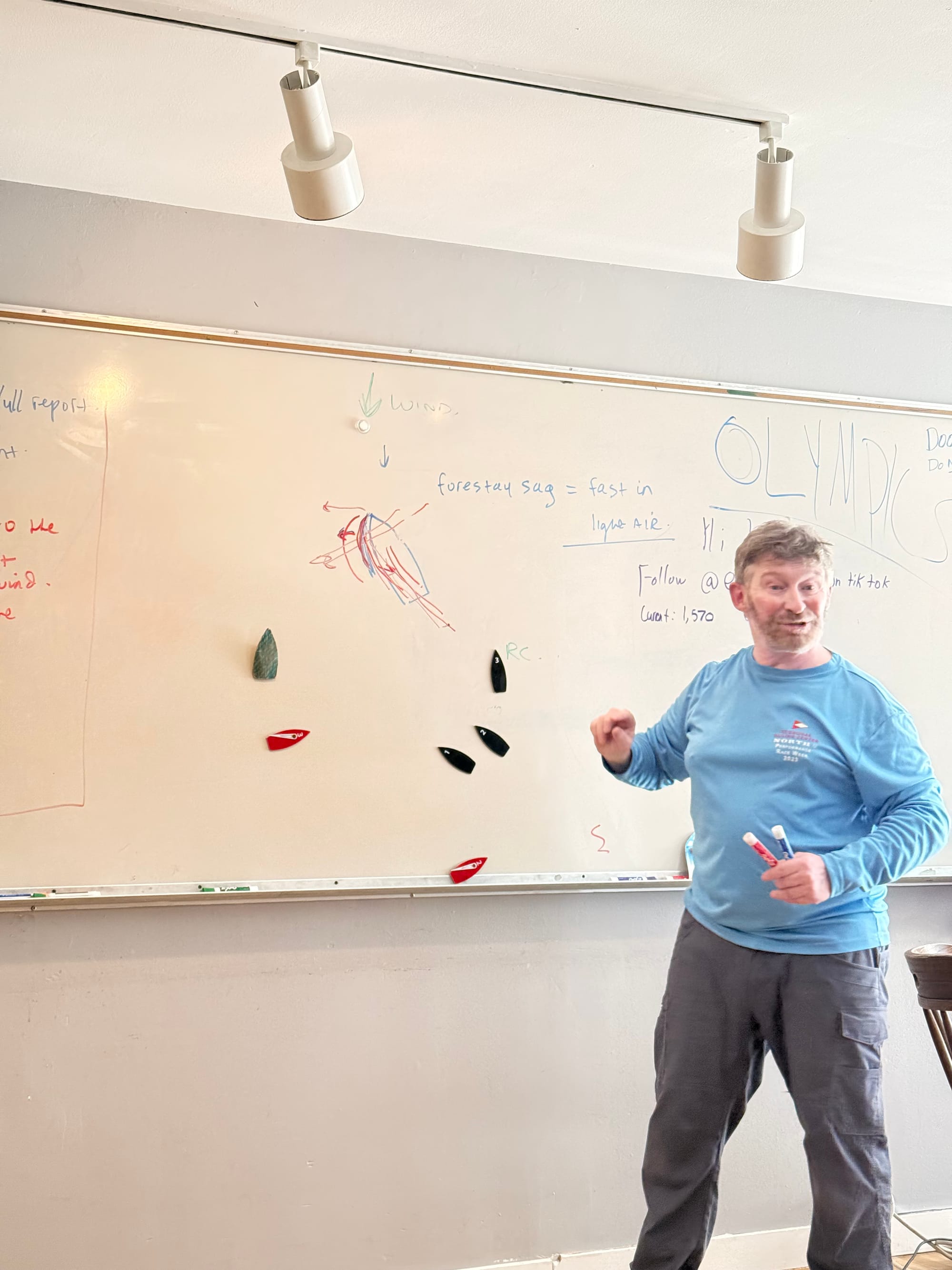
Conditions & Mode
- Light, “Seattle” day: mostly underpowered → think first gear/acceleration mode.
- Goal: keep flow attached and build speed; prioritize power and acceleration over height.
Rig & Trim Principles (Light Air)
- Forestay/Headstay sag is fast in light air.
- Creates a rounder jib, opens the luff, improves sensitivity/acceleration.
- On fractional rigs (J/80): call it forestay sag (vs. “headstay” on masthead rigs).
- To induce sag: Backstay off. Pair with looser jib halyard so draft doesn’t live too far forward.
- As breeze builds, pressure pushes the jib rounder and aft/outboard → risk of excessive back-winding on main.
- Counter with backstay on (primary tool) to straighten headstay, flatten main, and redirect flow along (not into) the main.
- Jib halyard can help but is secondary to backstay for headstay control.
Jib Halyard Effects (check them!)
- Primary: draft position (ease = draft aft; tighten = draft forward).
- Secondary: leech profile/twist surrogate
- Ease halyard → head moves toward clew → freer leech (like moving lead aft).
- Tighten halyard → tighter/straighter leech (like moving lead forward).
- Workflow: set “fast average” halyard for proper draft (~32–42% aft band, per your notes/tools), then play backstay dynamically for puffs/lulls.
Diagnostics & “What it’s Telling You”
- Big main back-wind bubble = likely too much forestay sag for current wind → add backstay, consider a touch more halyard.
- Underpowered feel, slow acceleration = add sag (backstay off), ease halyard a hair, keep leeches open, reduce friction/over-trim.
Comms, Process & Small Wins
- Loved: “Give me 15–20 seconds” call during fouls/tangles — buys time, lowers stress, improves execution.
- Maintain role handoffs when rotating: pause to re-organize lines/zone before the next sequence.
Common Issues & Fixes
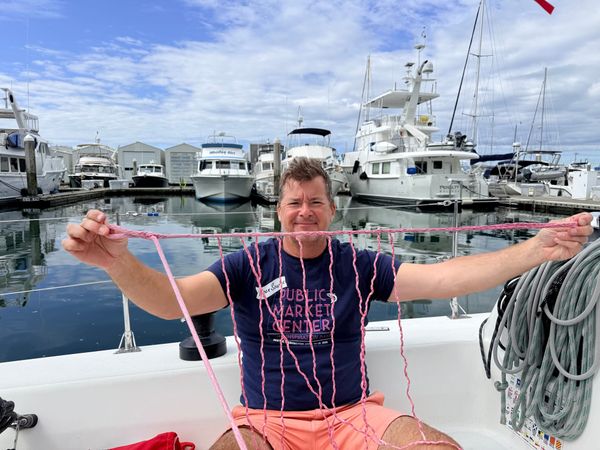
- Line management: tangles and bowlines slipping on kite clews.
- Standardize knot checks (bowline tails), assign a housekeeping owner, and avoid “over-tidying” coils that layer into overrides.
- Sprits/tack wraps & shrimping: stay calm, use lazy-sheet fix, rerun clean; coach/crew call the 15-second reset.
Light-Air Downwind Technique (Key Reminder)
- At bear-away in ≤5–6 kt: do NOT dump to a deep reach. You’ll lose apparent wind and stall the kite.
- Sequence:
- Shallower bear-away, fill the kite, spinnaker trimmer confirms pressure on.
- Build speed (create apparent wind), then step down in small angles toward VMG.
- Use slight leeward heel to help turn and keep pressure.
- Trimmer is the governor: if no pressure, call “head up 10–15°”, count 3 seconds to build, then work back down.
Team Puffs & Lulls (round-table themes)
- Highs: smoother spinnaker sets/douses, coordinated maneuvers with less chatter, winning a practice race via shared tactics, consistent rabbit-drill lineups.
- Lows: line spaghetti, kite clew knots coming loose, getting stuck in holes, two “shrimpings,” late backstay releases.
- Coach tip: practice “Quick Eyes” — glance sail shape → make micro-adjustment → immediately scan water for next puff/shift. Repeat.
Actionable Playbook (Light-Air Upwind)
- Backstay off (induce sag), ease jib halyard to set draft aft, keep main twist open, traveler up as needed.
- Trim to flow first, then climb; protect acceleration.